Your Cover Is an Ad, Whether You're Running Ads or Not
Every book cover on Amazon is a thumbnail. Whether a reader finds your book through search, browse, also-bought recommendations, or a paid ad, they're seeing it at roughly 120 x 180 pixels. That's smaller than a postage stamp on most screens. And they're making a click-or-skip decision in under 3 seconds.
If you're spending money on Amazon Ads (AMS), this becomes even more critical. You're paying for every impression. Every time someone sees your cover and doesn't click, that's wasted ad spend. The difference between a 0.2% click-through rate and a 0.5% CTR is the difference between losing money and making money on ads. And the cover is the primary driver of that click.
The Thumbnail Test You Should Run Right Now
Open your book's Amazon page. Now shrink your browser window until your cover is the size it appears in search results and ad placements. Can you read the title? Can you tell what genre it is? Does the main image element still register, or does it turn into an indistinct blob?
If the answer to any of those questions is no, your cover is costing you money. It might look beautiful at full size. But full size doesn't matter. Thumbnail size is where the buying decision happens.
Rule 1: High Contrast Between Text and Background
This is the single most important factor in thumbnail performance. Your title needs to be instantly readable against the background image. Light text on dark backgrounds. Dark text on light backgrounds. If your title blends into the imagery even slightly, it disappears at thumbnail size.
Common mistakes: white text over a light sky, dark text over a dark forest, colored text that matches the dominant color in the image. All of these look fine at full size and become unreadable at 120 pixels wide.
The fix is simple. Add a subtle dark overlay behind light text, or a light glow behind dark text. Or choose a composition where the title sits in a naturally contrasting area. Genre-savvy cover design accounts for this from the start.
Rule 2: Bold, Simple Typography
At thumbnail size, thin fonts disappear. Script fonts become illegible. Decorative fonts turn to noise. The covers that perform best in Amazon Ads use bold, clean typography that remains readable at any size.
This doesn't mean every cover needs blocky sans-serif text. Genre matters. Romance can use elegant serif fonts. Thrillers use bold sans-serif. Fantasy can use stylized display fonts. But within your genre's conventions, choose the boldest, cleanest option. If you have to squint to read it at thumbnail size, the font is wrong.
Title size matters too. The title should be the dominant text element on the cover. If your author name is bigger than your title (and you're not a household name), the hierarchy is wrong.
Rule 3: One Strong Focal Element
Covers with multiple competing elements, a character AND a building AND a landscape AND a symbol, turn to visual noise at thumbnail size. The strongest ad-performing covers have one clear focal point:
• A single figure silhouetted against a dramatic background.
• One bold object centered on a clean background.
• A striking color block with typography as the focal element.
• A close-up face or figure with minimal background distraction.
Minimalism beats realism at thumbnail scale. A cover that looks "too simple" at full size often outperforms a detailed, complex cover in ad performance because the brain processes it instantly.
Rule 4: Genre Signals That Register Instantly
Readers browsing Amazon have trained their brains to recognize genre from visual cues. Dark cover with red accents? Thriller. Pastel colors with illustrated couple? Romance. Metallic text on black? Sci-fi. These are genre codes, and they need to register in the 3-second window.
If your cover requires someone to read the blurb to figure out the genre, it's failing at the thumbnail level. The genre should be obvious from the visual treatment alone. Color palette, typography style, imagery type, and overall mood should all point to the same genre without any ambiguity.
Designing Thumbnail-First with AI
One of the biggest advantages of creating covers with AI is the ability to generate and test multiple compositions quickly. Instead of hoping your one commissioned cover works at thumbnail size, you can generate 10 variations and test which one performs best before spending a dollar on ads.
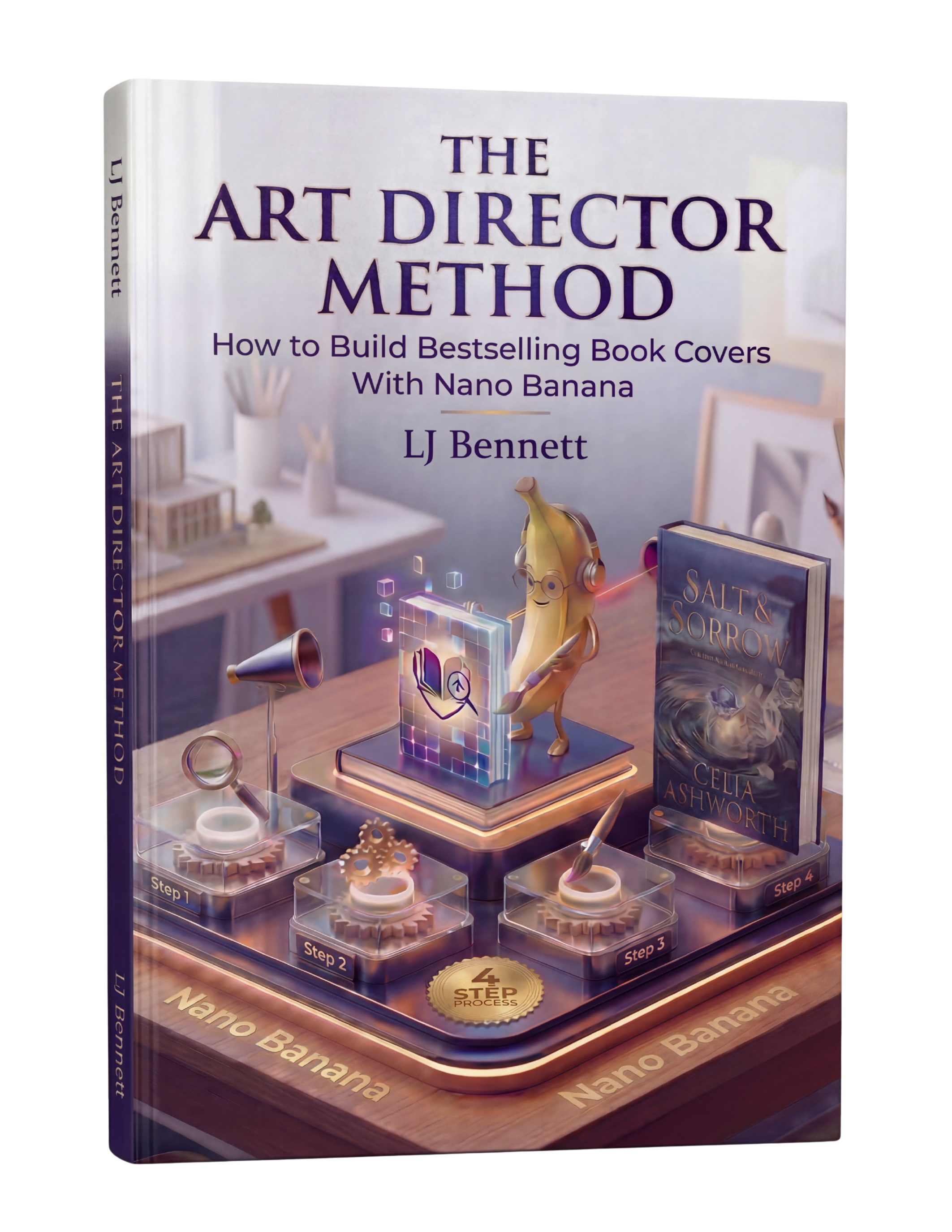
The Art Director Method teaches this thumbnail-first approach using Google Gemini's Nano Banana. The 88-page guide covers genre codes (so your cover signals the right genre instantly), conceptual prompting (so you get compositions that work at any size), and the full creative direction workflow. For authors running Amazon Ads, the ability to test cover variations without paying a designer for each one can pay for the $19.99 guide with a single ad campaign's improved performance.
This is exactly what The Art Director Method using Nano Banana teaches you to do right.
Turn Nano Banana from a slot machine into your creative partner.
Get the Guide - $19.99Frequently Asked Questions
A good Amazon Ad cover has high contrast between text and background, bold readable typography at thumbnail size, one strong focal element instead of a busy composition, and clear genre signals that register in under 3 seconds. Minimalism and contrast outperform detailed realism at the small sizes where Amazon displays covers.
Amazon displays book covers at roughly 120 x 180 pixels in search results and ad placements. This is smaller than a postage stamp on most screens. Any design element that isn't visible and clear at this size is effectively invisible to potential buyers browsing Amazon.
Shrink your cover to 120 x 180 pixels and check three things: Can you read the title? Can you identify the genre from visual cues alone? Does the main image element still register clearly? If any answer is no, the cover needs revision for thumbnail performance. AI tools let you generate and test multiple variations quickly.
If your Amazon Ad click-through rate is below 0.3%, your cover is likely the problem. A cover redesign focused on thumbnail readability (contrast, bold typography, simple composition) can significantly improve CTR. Using AI with The Art Director Method ($19.99), you can generate multiple variations and A/B test them for the cost of a small ad budget.